
The canal was never a commercial success and its operation was affected by a series of problems.
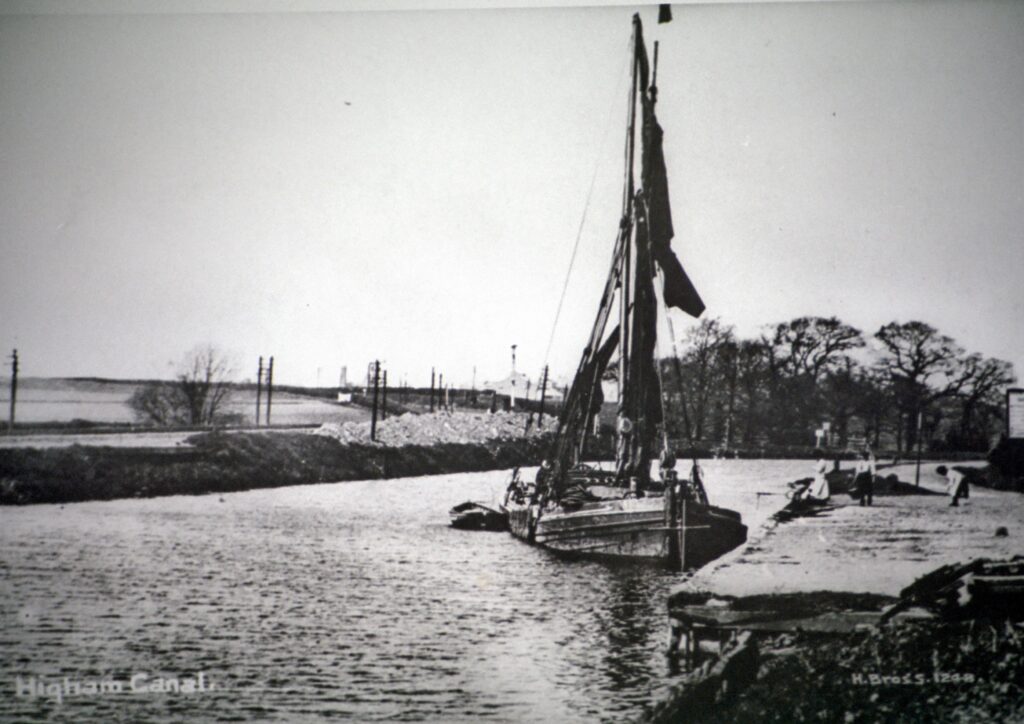
The canal bed leaked and the water level fell so much that a steam pumping engine had to be installed at Gravesend to top up the water.
Barge owners soon discovered that if the tide was against them, they could find themselves waiting longer for the locks to open than the time of the original journey around the Hoo Peninsula.
Tolls (charges to use the canal) were always high in an attempt to offset the enormous costs of construction. In 1825, it cost 2s 6d per ton to transport hops or wool – which had always been thought of as the main cargo for canal users. A passenger service was set up to add some revenue, but the steam boat used damaged the tow path and it had to be abandoned.
The tunnel was a particular issue and barge owners complained about the long wait at either end to allow traffic to pass through. In response, in 1830 the operators had a wide open-air basin dug half-way along to provide a passing place.

By this time the country was beginning to succumb to the appeal of the railway. The canal company decided their only option was to build a track alongside their waterway. The problem was the tunnel.
A single track railway was laid half on the towpath and half supported by trestles in the water, allowing use of the tunnel for trains. It was the only example of this form of construction in a tunnel in the country. The new Gravesend and Rochester Railway and Canal Company ran its first service on 10 February 1845.
In Summer Excursions in the County of Kent along the River Thames and Medway (1847), William Orr got full value out of the apparently dubious nature of this arrangement:
The ride through the dreary tunnel with the dark waters of the canal beneath us, and an insecure chalk roof above our heads, enlivened as it is by occasional shrieks from the engine’s vaporous lungs, and the unceasing rattle of the train, is apt to make one feel somewhat nervous; and the first glimpse of bright daylight that breaks upon us, relieves us from a natural anxiety as to the chances we run of being crushed by the fall of some twenty tons of chalk from above, or being precipitated into twenty feet of water beneath…
RIGHT: The tunnel at Strood showing the railway alongside the canal (Victorian Web)
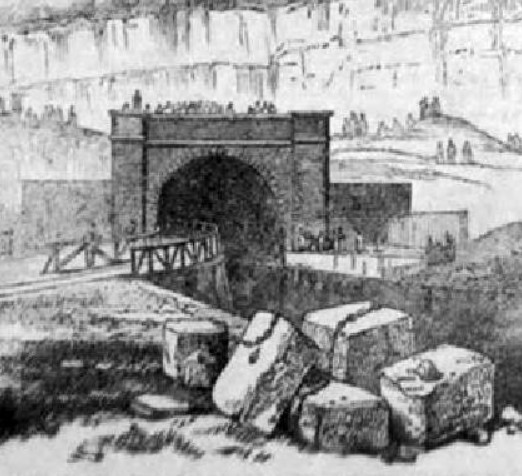
The line was soon bought by the South Eastern Railway Company and its first task was to fill the waterway in the tunnel and install a double railway track. The canal was thus separated from its basin in Strood and the outlet into the River Medway.
The Gravesend portion of the canal was still used for transporting coal to British Uralite (now the Nuralite Industrial Estate) and manure to Dung Wharf in Higham up until 1934, when it was finally closed.